




Excellence Award at the 2026 16th DB Insurance & Finance Contest (Student Lee Raekyung)
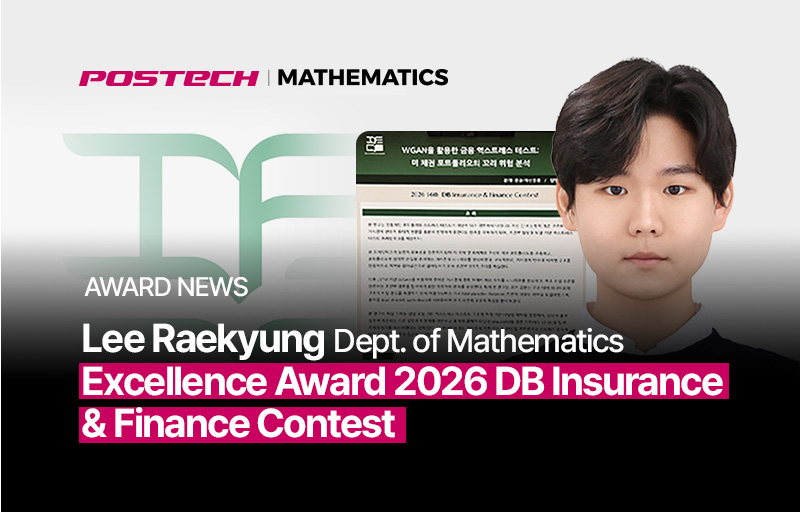
Lee Raekyung, a student in our department, received the Excellence Award in the Securities/Asset Management category at the '2026 16th DB Insurance & Finance Contest' ceremony held on Friday, May 22, 2026. The award was achieved through collaborative research with Oh Inhyuk from the Department of Bio and Brain Engineering at KAIST.
The DB Insurance & Finance Contest is a competition hosted and sponsored by the DB Joon-Ki Culture Foundation and DB Insurance, established to discover creative and practical financial research in the fields of insurance/banking, securities/asset management, and economics. Now in its 16th year, the contest is open to undergraduate and graduate students across Korea, with winners receiving scholarship prizes and the special benefit of global financial study tours to the United States and Asia.
Lee Raekyung's award-winning paper, "Financial Reverse Stress Testing Using WGAN: Tail Risk Analysis of a U.S. Bond Portfolio," explores the macroeconomic conditions that could lead to significant losses in a U.S. bond portfolio through a reverse-engineering approach. While conventional stress tests begin by assuming a crisis scenario — such as rising interest rates or a recession — and then estimate resulting portfolio losses, this research takes the opposite direction: it first sets a target loss level and then identifies the macroeconomic paths necessary to produce that loss. Key macroeconomic variables relevant to the U.S. bond market were employed, including interest rates, the yield curve, credit spreads, the VIX index, and dollar liquidity. An LSTM-based WGAN was used to generate bond return scenarios conditional on specific macroeconomic paths. Beyond simply searching for extreme loss scenarios, the study also assessed the structural plausibility of each scenario by measuring its deviation from historical covariance structures using a Mahalanobis distance-based validity constraint, ensuring that only realistic crisis paths were retained. Macroeconomic shocks were further decomposed into level shocks and path shocks to analyze the structural characteristics of each crisis episode. The research was highly regarded for its contribution of a reverse stress testing framework that quantitatively identifies the macroeconomic conditions under which bond portfolios become vulnerable — and interprets their economic significance — offering practical applications in risk management, crisis scenario design, and portfolio vulnerability assessment for financial institutions.

 ?php echo aslang('alert','is_login_service'); ?>